CASE STUDY:
Wastewater Treatment Installation for Flue Gas Desulfurization – A Case Study Over Time
COMPANY: Refinery (Industrial Sector Client)
INDUSTRY: Petrochemical / Energy
CHALLENGE: Lack of an integrated control and monitoring system for the wastewater treatment plant, hindering efficient process management and compliance with increasing environmental regulations
How Is the Approach to Industrial Automation Evolving?
Some projects illustrate not only what has been delivered, but also how the way we think about technology evolves over time.
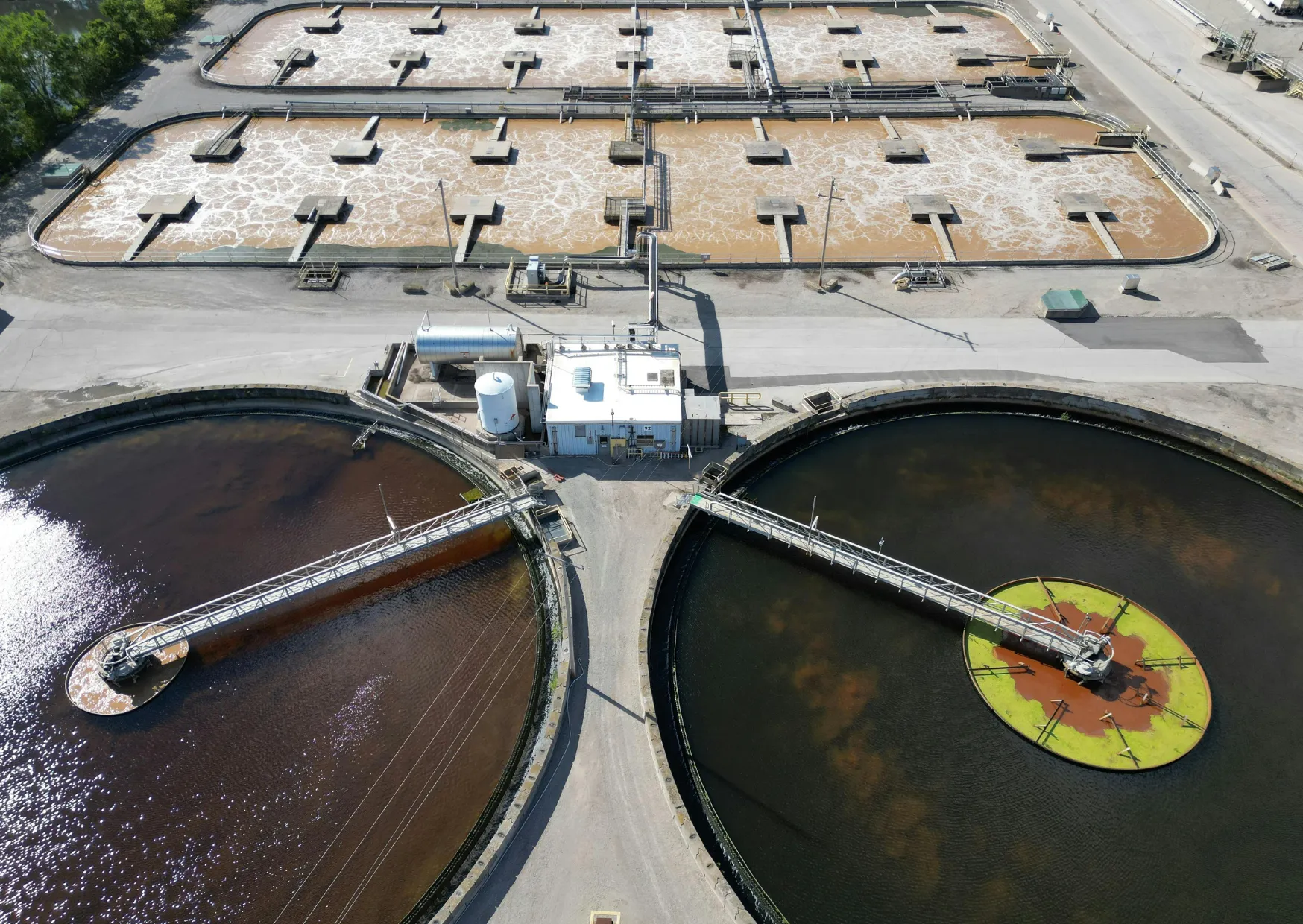
One such example is the implementation of a control system for a wastewater treatment installation linked to a flue gas desulfurization process at a refinery – a project we delivered several years ago.
From today’s perspective, it serves as an interesting case of how solid technological foundations remain relevant, while at the same time the possibilities for their further development have significantly expanded.
Project Context – The Need for Stability and Compliance
Wastewater treatment installations in the petrochemical industry play a critical role – not only operationally, but also environmentally.
In this case, the key challenge was to ensure stable and safe operation, meet stringent environmental standards, and improve the efficiency of technological processes.
The client required a comprehensive solution – one that would cover both the hardware and system layers.
Scope of Work – MJ Group’s End-to-End Approach
The project was delivered in an end-to-end model – from concept to commissioning.
The scope included:
development of design and as-built documentation in the electrical and I&C (Instrumentation & Control) scope,
prefabrication, delivery, and commissioning of control cabinets,
execution of electrical installations and cabling,
implementation of a control system based on Siemens SIMATIC S7-1500 PLC,
deployment of a process visualization system based on Siemens WinCC,
development of a monitoring, data archiving, and reporting system.
The result was a coherent control environment integrating all key elements of the technological process.
Implementation Results – Control, Safety, Efficiency
The implemented system ensured full control over the wastewater treatment process, including:
real-time monitoring of installation parameters,
alarm management and rapid response to deviations,
recording and analysis of historical data,
optimization of equipment performance and process flows.
For the client, this translated into improved operational stability, compliance with environmental requirements, enhanced process efficiency, and the ability to further expand the system.
At the time of delivery, the solution was fully modern and aligned with best industry practices.
“Then” Perspective – A Well-Designed Foundation
From today’s perspective, one thing is worth emphasizing – the system architecture was designed in a thoughtful and scalable way. This is precisely why the solution continues to perform effectively.
PLC controllers, the SCADA system, and the communication structure were all selected to ensure not only current functionality, but also future development potential. And this is something that does not change – good automation always starts with solid foundations.
“Today” Perspective – What Would We Do Differently?
Technology does not stand still – and industry is increasingly integrating with data, IT, and analytics.
If we were to design a similar installation today, we would extend it with additional layers:
1. The control system would be designed with a broader data flow in mind – not only within the installation, but also towards business and analytical systems.
2. We would implement solutions enabling secure remote access – both for service and operational purposes.
3. Process data would be used not only for monitoring, but also for predictive purposes – for example in maintenance or resource consumption optimization.
4. The SCADA system would be extended with web-based interfaces and multi-platform access – enabling operation across different devices.
5. A significantly greater emphasis would be placed on industrial cybersecurity – both at the network level and in terms of user access control.
Summary:
Despite the dynamic development of technology, the foundations of success remain unchanged.
A well-thought-out architecture and full system integration are still key, while experience in delivering industrial projects remains the decisive factor.
Although new tools significantly expand our capabilities, it is these core principles that determine whether a system will operate reliably for years to come.
This project is a good example of real evolution in industry.
It is not about completely changing the approach, but about expanding it – with data, integration, and new technological possibilities.
At MJ Group, we build robust systems, design them with the future in mind, and continuously develop them in line with market needs.


See selected projects