Optimising aeration and other wastewater treatment plant processes
TL;DR
Aeration is usually the wastewater treatment plant’s largest electricity consumer, so this is where the benefits can often be seen first.
The key is not replacing blowers, but controlling them intelligently: reliable measurements, a supervisory optimisation system and making better use of the equipment already in place.
This article explains the process step by step, the results it can deliver and how to implement it without shutting down the plant.
Optimising aeration in wastewater treatment plants is one of the questions most frequently raised by operators and process engineers today. That is hardly surprising. Electricity bills are rising, while requirements for treated wastewater quality remain demanding. Many assume that the answer is to replace the blowers or the entire installation. However, modernising a treatment plant is not just about installing new equipment. Much of the potential lies in how you control the equipment you already have.
Below, we explain where to start, where to look for savings and how implementation can be carried out without shutting down the plant.
Optimising aeration in a wastewater treatment plant: where to start
Let’s start with a simple fact: aeration typically consumes more energy than any other process at a wastewater treatment plant. This is usually a major reason for high electricity bills, which is why it is the first place to look for savings.
What does optimisation actually involve? It is not about slowing the blowers down by guesswork. It is about supplying exactly as much oxygen as the microorganisms need at a given moment. No more and no less.
The key elements we look at are:
- Dissolved oxygen (DO) – this is a key parameter. If you maintain it at a consistently high level around the clock, you may be spending more than necessary. Oxygen demand changes throughout the day as wastewater inflow changes.
- Blower control and variable frequency drives (VFDs) – instead of switching a blower on and off, you can adjust its output smoothly. This may be simpler and less expensive than you think.
- Recirculation – both internal and external. When managed well, recirculation supports nitrification and denitrification while also helping to reduce aeration demand.
- Making use of existing measurements and controllers – there is no need to build everything from scratch. Often, you can use the equipment already in place and add a layer that takes a broader view of the process.
This brings us to a term worth remembering: supervisory control system. This is a layer that considers the process as a whole rather than focusing on a single device. It collects sensor data, analyses it and determines setpoints for blowers, pumps and valves. In other words, it tells the automation system what to do to improve process performance.
This is how the CREA® platform works. It determines blower setpoints using real-time data, while MJ Group integrates the platform with the plant’s existing automation system. No controller replacement and no need to overhaul the installation.
Aeration is not the only process that can be optimised. Other areas include recirculation, sludge management, nitrification and denitrification. Each affects energy consumption and the stability of treated wastewater parameters.
Why PLC/SCADA automation alone is not enough
This is one of the most important points in any discussion about savings. Many assume that having PLC and SCADA means they already have everything they need. Not quite.
Conventional automation does one thing very well: it keeps the process stable. It ensures that parameters stay within limits, alarms work and operators can see what is happening. This is essential. But a PLC does not search for the optimum; it executes the logic it has been programmed to follow.
Consider a simple example. A blower operates at a fixed setpoint established during the design stage. At night, when wastewater inflow is lower, it continues to deliver the same amount of air. During the day, when the load increases, it may not deliver enough. Nothing adjusts the setting because the system has no mechanism to do so.
Optimisation takes a different approach. It considers the process as a whole: the current load, wastewater quality, energy consumption and the operation of other equipment. It then uses this information to determine better setpoints. This is the difference between keeping a process under control and guiding it along the best possible path.
As an integrator, MJ Group connects these two layers. We do not replace equipment that works. We use the existing automation and add a layer that takes a broader view. This means you do not have to replace SCADA or introduce another system that must be operated from scratch.
What is CREA® and how does it work with your treatment plant?
CREA® is a platform for optimising wastewater treatment processes, developed by Createch360°. MJ Group is the Polish partner responsible for integration and implementation support. Put simply, the technology is provided by Createch360°, while MJ Group ensures it works within your installation and provides a local point of contact.
What does this mean in practice? Above all, one point of responsibility, from concept and integration through to service. This reflects MJ Group’s “more than you expect” philosophy, followed since 2006.
Key features of the solution:
- It works with existing automation, regardless of the PLC, SCADA or instrumentation manufacturer,
- It is installed on-site, supporting cybersecurity and control-system security,
- It uses real-time process data,
- It supports the optimisation of aeration, recirculation, sludge management, nitrification and denitrification,
- It determines optimal setpoints instead of simply displaying more charts and alarms,
- It helps reduce energy consumption and stabilise treated wastewater parameters,
- It does not require replacement of the existing PLC, SCADA or instrumentation and control infrastructure.
On-site installation is not a minor detail. In the context of NIS2 and IEC 62443, process data remains within your infrastructure rather than being sent to the cloud. This matters to critical infrastructure operators, who must treat OT security as a priority alongside performance.
What results can optimisation deliver? Implementation data
Claims mean little without figures. That is why we share results from CREA® implementations. Energy savings range from 13% to 35%, depending on the facility and its starting point.
| Facility | Capacity | Energy savings | CO₂ reduction |
|---|---|---|---|
| Łódź, Poland | 215 300 m³/d | 17% | 646 tCO₂/year |
| Radocha II, Poland | 65 000 m³/d | 20% | 218 tCO₂/year |
| Barcelona–Baix Llobregat, Spain | 420 000 m³/d | 35% | 1 400 tCO₂/year |
| Besòs, Spain | 525 000 m³/d | 19% | 772 tCO₂/year |
| Brembate, Italy | 53 600 m³/d | 25% | 105 tCO₂/year |
These results are backed by a partner with more than 100 implementations worldwide and over 20 years of experience. This is not a one-site experiment, but an established approach applied in different conditions.
What does this mean for you? You do not have to guess whether optimisation is worthwhile. MJ Group provides access to a proven platform and local support, so the work does not end with installation.
A practical example: wastewater treatment for flue-gas desulphurisation
It helps to see what this looks like in practice. Consider a wastewater treatment installation for flue-gas desulphurisation, delivered for a facility in the refinery sector.
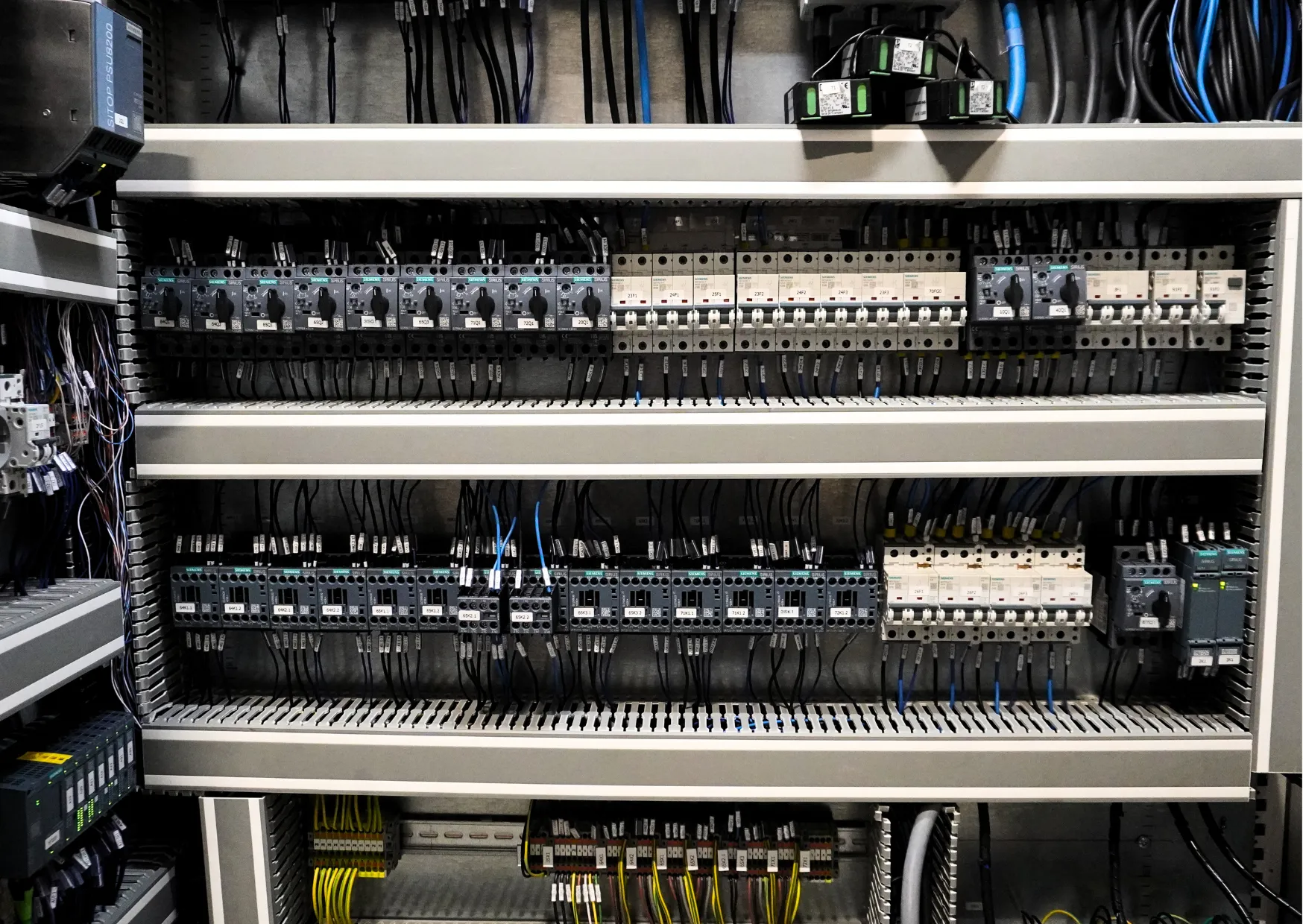
The scope was extensive: electrical and instrumentation and control documentation, fabrication and commissioning of control cabinets, electrical installations and implementation of the control system. The system was built around a Siemens SIMATIC S7-1500 controller, with visualisation and supervision provided by Siemens WinCC.
The result? Real-time monitoring, effective alarm management, data archiving and reporting, and optimisation of equipment operation and flows. MJ Group delivered the project as a single contractor, from design through to commissioning.
This shows that process optimisation and robust automation go hand in hand. First, establish reliable data and control; then add a layer that helps the process deliver more.
What implementation looks like, step by step
Does it sound complicated? In practice, implementation follows a structured process:
- Data and measurement analysis – we check what is already being measured, the quality of the data and where gaps remain.
- Sensor selection – if measurements essential to optimisation are missing, we select what is genuinely needed.
- PLC/SCADA integration – we connect the new layer to the existing automation without replacing it.
- Control strategy commissioning – the system begins determining setpoints and guiding the process.
- Results validation – we compare results before and after implementation to establish what has actually changed.
- Service and predictive maintenance – we remain available after implementation to help keep the system running well for years.
MJ Group supports you throughout the process, including post-warranty service. You are not left to manage the new system on your own.
What to watch out for
The greatest implementation risk is not the technology itself, but measurement quality. If sensors are out of calibration or the data is unreliable, no optimisation system will perform well. Calibration and measurement verification are therefore essential at the outset. Regular instrumentation inspections are also important to sustain results over time.
FAQ
Do PLC/SCADA systems need to be replaced?
No. CREA® works with existing automation, regardless of the manufacturer. MJ Group integrates the platform with your current setup, so there is no need to replace controllers or the supervisory system.
How much energy can be saved?
CREA® implementations have delivered energy savings ranging from 13% to 35%. The actual result depends on the facility, its starting point and the scope of optimisation.
Does the data stay on-site?
Yes. CREA® is installed on-site, so process data does not leave your infrastructure. This is important for OT cybersecurity.
How long does implementation take?
It depends on the scope and condition of the installation. We begin every project with an assessment and agree on a schedule individually. We do not promise fixed timelines before understanding your treatment plant.
Will the system work with my instrumentation?
Yes. The solution works regardless of the instrumentation manufacturer. If key measurements are missing, we can help select suitable sensors.
Does it meet NIS2 and IEC 62443 requirements?
On-site installation and the approach to control-system security align with the requirements of NIS2 and IEC 62443. MJ Group can also help with OT/IT network segmentation.
Modernising your treatment plant? Get in touch
Optimising aeration and other processes does not have to mean replacing blowers or shutting down the plant. In many cases, good control, reliable measurements and a layer that takes a broader view of the process are enough. This is where MJ Group combines existing automation with supervisory optimisation, from concept through to service.
You might be interested in:


Read more

Read more