Modernizing outdated automation without stopping production – how MJ Group plans and executes retrofit projects that minimize downtime
TL;DR
Modernizing automation without downtime is possible – the key is proper preparation: audit, offline simulation, prefabrication of control cabinets, and replacement using a “hot-swap” model during a weekend shutdown. MJ Group carries out migrations, e.g., from S5 to S7, in 2–5 days of downtime instead of 3–4 weeks. This saves not only time but also costs – a retrofit amounts to 30–60% of the price of a new machine, and the return on investment occurs within 12–36 months.
The pressure to maintain production continuity has never been greater. According to the Senseye report (2023), global losses caused by unplanned downtime among Fortune Global 500 companies reach $1.4 trillion annually – a 62% increase compared to 2019. The cost of a single hour of downtime in the automotive industry averages $2.3 million, in heavy industry around $187 thousand, and in the general manufacturing industry between $25 and $39 thousand. In Polish realities, this often means losing an entire week’s margin after a single critical line failure.
Meanwhile, machines and production lines operating on outdated control systems are becoming ticking time bombs. Missing parts, phased-out technical support, and the growing risk of cyberattacks are real problems affecting plants that delay modernization.
Can control systems be replaced without stopping production for weeks? As it turns out, yes. This is exactly what MJ Group specializes in – an integrator of industrial automation systems from Wrocław, which has been executing retrofit projects for over 18 years in the energy, automotive, food, pharmaceutical, and chemical sectors, frequently shortening downtime from weeks to just a few days.
Why modernizing outdated automation is a necessity today, not a choice?
Market and technological pressure
In a 2025 PwC report, as many as 46% of industry leaders stated that without undergoing modernization, their companies would not survive the next decade. This is not fear-mongering – it is a diagnosis of a market where competitive advantage is built on efficiency, flexibility, and reliability.
Plants relying on old control systems lose out not only due to breakdowns but also through lower efficiency. McKinsey reports indicate that automation modernization allows for increasing production line efficiency by 10–30% and reducing unplanned downtime by up to 50%.
Legal regulations – EU Machinery Regulation 2023/1230
The new European Union Regulation (EU) 2023/1230, which comes into force on January 20, 2027, imposes an obligation on machine manufacturers and users to ensure compliance with new safety requirements.
Outdated control systems that do not meet cybersecurity standards and do not allow for the implementation of required safety functions will have to be replaced. Delaying modernization until the last minute is a direct path to stressful, expensive, and poorly planned projects.
Rising maintenance costs of old systems
The Siemens S5 environment, which was an industry standard just a dozen years ago, is practically dead today. Lack of technical support, difficulties accessing original parts, and high prices on the secondary market mean maintaining such systems costs more and more, while the risk of failure increases exponentially.
The situation is similar for old versions of SCADA that are incompatible with new IT systems and cybersecurity requirements.
Retrofits pay off in 12–36 months
Industry data shows that automation modernization (retrofit) costs 30–60% of the purchase price of a new machine, and the return on investment occurs within 12–36 months.
For comparison, the cost of purchasing a new production line often runs into millions of PLN with waiting periods measured in months, not to mention the need to rebuild infrastructure and retrain personnel.
| Comparison | New machine/line | Retrofit (modernization) |
|---|---|---|
| Cost | 100% | 30–60% of the price of a new one |
| Lead time | 6–18 months | 2–6 months |
| Production downtime | Weeks to months | 2–5 days (with a good plan) |
| Return on investment | 2–5 years | 12–36 months |
| Operational risk | High (new infrastructure) | Low (retaining mechanics) |
| Impact on production | Total shutdown + changeover | Minimal, planned downtime |
| Need for structural changes | Often yes | Usually no |
How to plan automation modernization to minimize downtime?
The key element of automation modernization without downtime is proper preparation. The more work that can be completed before physical intervention in the installation, the shorter the actual production shutdown will be.
MJ Group applies a proven methodology based on three pillars that consistently reduce implementation risks and significantly shorten commissioning times.
Offline programming and simulation (virtual commissioning)
The traditional approach involves programming the controller only after the physical replacement of equipment on the shop floor. This often leads to extended downtime because every coding error requires additional debugging on a non-operational production line.
MJ Group uses a modern approach based on offline simulation and virtual commissioning. PLC code is developed and tested before it ever reaches the production environment.
For projects involving Siemens S7-1500 platforms, engineering teams use TIA Portal together with simulation tools such as S7-PLCSIM and Digital Twin environments. This enables verification of control logic, machine sequences, alarms, and communication structures long before installation.
Benefits include:
- Up to 80% of programming issues identified before commissioning.
- Commissioning time reduced from weeks to days.
- Operator and maintenance training before go-live.
- Reduced startup risk during production shutdown windows.
Prefabrication and preparation of control cabinets
In a traditional modernization project, replacing a control system means dismantling an existing cabinet, installing a new one, and wiring everything on-site during production downtime.
MJ Group reverses this process.
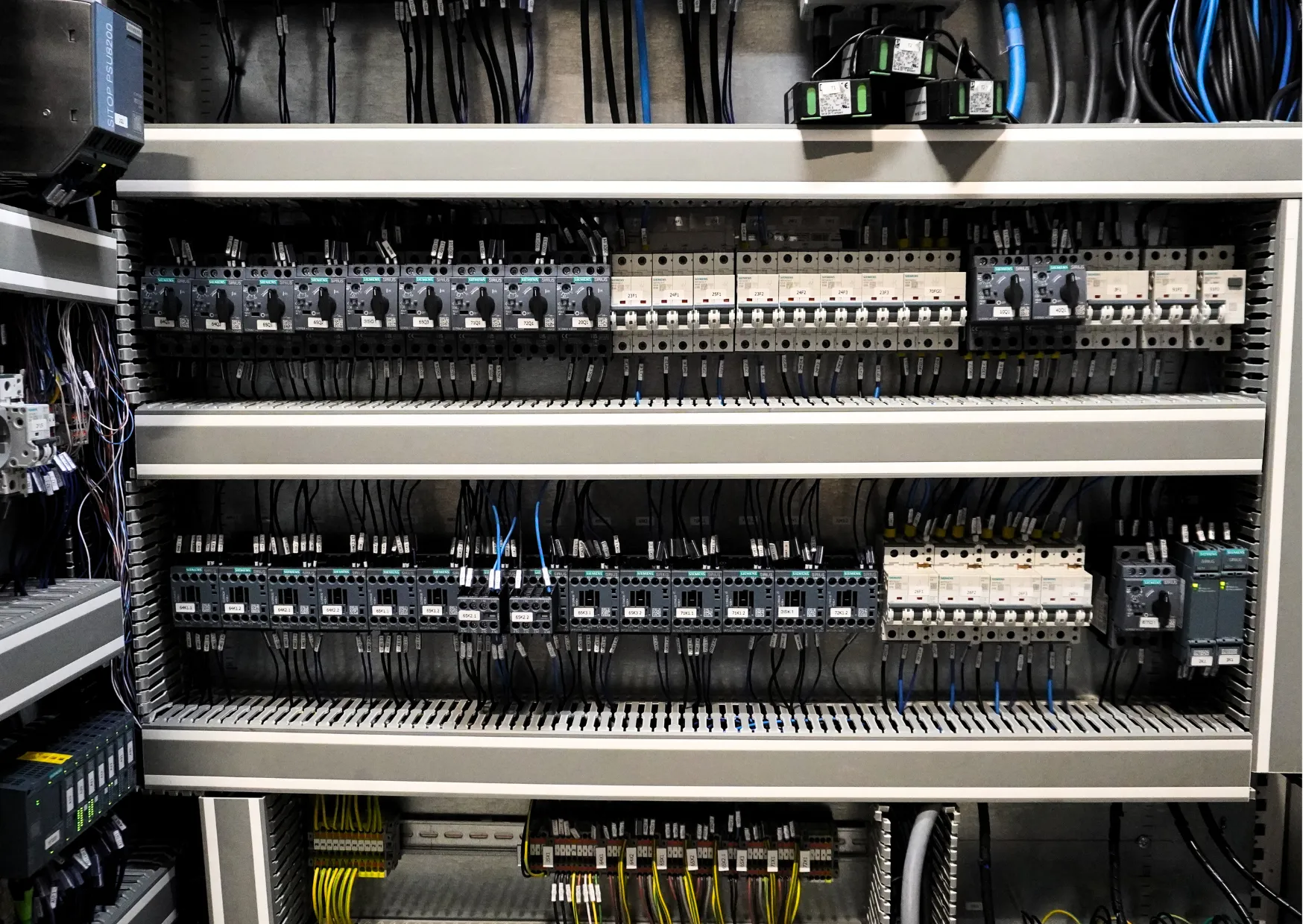
The new control cabinet is fully assembled, wired, tested, and documented in the workshop before arriving at the plant. Detailed audits and signal inventories make it possible to prepare dedicated harnesses and connection interfaces in advance.
As a result, site activities are limited mainly to:
- Positioning the new cabinet.
- Connecting prepared wiring harnesses.
- Verifying communication.
- Executing commissioning procedures.
This approach reduces installation work from several days to just a few hours and dramatically lowers the risk of wiring errors.
Audit and inventory before project execution
Every successful retrofit starts with a comprehensive technical audit.
Before any replacement work begins, MJ Group engineers perform a detailed analysis of the existing installation.
The audit typically includes:
- Inventory of all DI, DO, AI, and AO signals.
- Analysis of existing PLC source code.
- Identification of critical control functions.
- Assessment of sensors, actuators, and field devices.
- Verification of communication networks.
- Evaluation of safety systems and redundancy structures.
- Measurement and validation of operating parameters.
Many older installations contain undocumented modifications made over years of operation. The audit allows engineers to uncover hidden dependencies before modernization begins.
Without a proper audit, modernization becomes a high-risk exercise. With it, over 90% of potential implementation issues can be identified before the first power cable is disconnected.
The execution phase – from replacement to commissioning in just a few days
Once the audit is complete, the software has been tested offline, and the control cabinet is fully prepared, the project enters its most critical stage: implementation.
This is where planning, engineering, and execution come together to determine whether the modernization will succeed within the available shutdown window.
Replacement during a weekend shutdown – the hot-swap approach
For most manufacturing plants, the preferred modernization window is a planned weekend shutdown or holiday maintenance period.
MJ Group frequently executes migrations using a hot-swap methodology.
Rather than immediately removing the old control system, the new cabinet is installed alongside the existing infrastructure. Production sections are then transferred progressively to the new system.
The sequence typically follows:
- Migration of non-critical auxiliary systems.
- Verification of stability and communication.
- Transfer of critical production sections.
- Final shutdown and removal of the legacy controller.
This staged approach minimizes operational risk because the existing system remains available as a fallback option throughout most of the migration process.
FAT testing and intensive onsite supervision
Before deployment, every modernization project undergoes a Factory Acceptance Test (FAT).
Depending on the project scope, FAT can be performed either in the MJ Group workshop or directly at the client’s facility.
Typical FAT activities include:
- Verification of all I/O signals.
- Functional testing of control sequences.
- Simulation of emergency and fault conditions.
- Communication testing with SCADA, MES, and ERP systems.
- Cybersecurity and protocol verification.
- Validation of safety functions.
Following commissioning, MJ Group engineers remain onsite to support startup activities, optimize parameters, train operators, and ensure the system performs according to design expectations.
This post-commissioning supervision is often the difference between a system that merely functions and a system that delivers measurable operational improvements.
Example schedule: S5 → S7 migration
| Phase | Time | Notes |
|---|---|---|
| Audit and inventory | 2–4 weeks before replacement | Detailed analysis of the legacy installation |
| Offline programming | 3–6 weeks | Testing in TIA Portal and simulation environment |
| Cabinet prefabrication | 2–3 weeks | Assembly and wiring in workshop conditions |
| FAT (Factory Acceptance Test) | 3–5 days | Verification of compatibility and functionality |
| Installation on site | 1–2 days | Connection of prefabricated wiring harnesses |
| Commissioning and switching | 1–3 days | Hot-swap implementation and phased migration |
| Post-implementation support | 5–10 days | Onsite supervision by MJ Group engineers |
From the first shutdown activity to full production readiness, total downtime can often be reduced to 2–5 days, compared to 3–4 weeks using conventional modernization approaches.
Benefits of modernization – measurable results for engineers and decision-makers
Modernizing an outdated control system is not only about eliminating the risk of breakdowns. It delivers measurable operational, financial, and organizational benefits that directly affect production performance and competitiveness.
-
- 10–30% increase in production efficiency through optimized control logic, faster diagnostics, and improved process stability.
-
- 20–50% reduction in energy consumption, particularly in systems using variable speed drives (VSDs), intelligent load control, and advanced process regulation.
- Improved cybersecurity through modern PLC platforms, network segmentation, encrypted communications, user authorization, and compliance with NIS2 requirements.
- Extension of machine lifespan by 10–15 years while preserving mechanically sound infrastructure.
- Industry 4.0 readiness through integration with MES, ERP, cloud analytics, remote diagnostics, OEE monitoring, and predictive maintenance systems.
- Reduced spare parts inventory thanks to controller standardization across multiple production areas.
- Improved operator ergonomics through modern HMI interfaces, alarm management, historical reporting, and enhanced process visibility.
“`
Most common mistakes in automation modernization
Based on experience gained from hundreds of retrofit projects, MJ Group has identified several recurring mistakes that frequently lead to delays, increased costs, and operational disruptions.
-
- Skipping the technical audit
Starting a migration without a complete inventory of signals, devices, and control logic creates unnecessary uncertainty and significantly increases project risk.
- Skipping the technical audit
-
- Programming directly during production downtime
Writing and debugging software on-site can extend shutdown periods by several days. Offline testing should always be completed before implementation begins. - Skipping FAT testing
Factory Acceptance Testing allows engineers to identify communication, configuration, and logic issues before they affect production. - Lack of a rollback strategy
Every modernization project should include a clearly defined fallback scenario allowing temporary return to the legacy system if necessary. - Insufficient operator training
New systems introduce new procedures, interfaces, and diagnostics tools. Training should take place before startup rather than under production pressure. - Poor timing of implementation
Even a technically perfect project can become problematic if it is executed during peak production periods.
- Programming directly during production downtime
“`
Case study – wastewater treatment plant modernization by MJ Group
The challenge
An industrial facility in south-western Poland operated a wastewater treatment plant controlled by Siemens S5-115U controllers installed in the late 1990s.
The installation managed aeration, chemical dosing, pumping, and filtration processes. Over time, maintenance costs increased significantly due to:
- Frequent failures of I/O modules.
- Limited availability of spare parts.
- Absence of remote diagnostics capabilities.
- Growing cybersecurity concerns.
Each unexpected failure required onsite intervention and often resulted in costly operational disruptions.
The solution
MJ Group performed a complete inventory audit covering more than 400 I/O signals and 16 distributed control stations.
The modernization project included migration to:
- Siemens S7-1500 PLC platform
- ET200SP distributed I/O system
- WinCC Unified SCADA environment
The implementation involved:
- Migration of legacy STL code to modern SCL and LAD structures.
- Workshop prefabrication of control cabinets.
- FAT testing using PLCSIM and process simulations.
- Three-day implementation during a planned shutdown period.
- Parallel operation of old and new systems during migration.
The results
-
- Downtime: 3 days instead of the planned 5 days.
-
- Reliability: zero critical failures during the first six months of operation.
- Remote diagnostics: complete process visibility through WinCC Unified Web Client.
- Energy savings: 18% reduction in energy consumption through optimized aeration control.
- Scalability: readiness for future MES integration and environmental reporting systems.
“`
Summary
Market pressure, cybersecurity requirements, and increasing maintenance costs leave little room for hesitation. Modernizing outdated automation is no longer a strategic option – it is a business necessity.
The challenge is not whether modernization should happen, but how to execute it without causing prolonged production interruptions.
Successful projects rely on a structured methodology that combines:
- Comprehensive technical audits.
- Offline programming and simulation.
- Control cabinet prefabrication.
- Factory Acceptance Testing.
- Hot-swap implementation strategies.
This approach has proven effective across industries ranging from automotive and food processing to energy generation and wastewater treatment.
Need to modernize an outdated automation system?
MJ Group provides complete retrofit services – from technical audits and engineering design to commissioning and post-implementation support.
Contact our team to assess your installation and discuss a modernization strategy tailored to your production environment.
MJ Group Sp. z o.o.
Business Garden Wrocław
ul. Legnicka 48A, 54-202 Wrocław, Poland
Tel. +48 690 880 229
E-mail: info@mjgroup.com
FAQ – frequently asked questions about automation modernization
Does automation modernization always require stopping production?
No. By combining prefabrication, offline testing, and hot-swap implementation methods, actual downtime can often be limited to just 2–5 days and scheduled during weekends or planned maintenance periods.
How much does a retrofit cost compared to purchasing a new machine?
A retrofit typically costs between 30% and 60% of the purchase price of a new machine or production line. Return on investment is commonly achieved within 12–36 months.
Can a Siemens S5 installation be migrated to Siemens S7-1500?
Yes. This is one of the most common modernization projects performed by MJ Group. Existing control logic can be mapped and migrated to modern Siemens platforms using TIA Portal while retaining much of the existing field infrastructure.
How long does a modernization project take from audit to commissioning?
A typical migration project takes between 6 and 8 weeks from the initial audit to final commissioning. Actual production downtime is usually limited to 2–5 days.
Will the new system comply with NIS2 and cybersecurity requirements?
Yes. Modern automation platforms support network segmentation, encrypted communication, user authentication, audit trails, and other features required for compliance with current cybersecurity standards.
Sources
- Senseye/PTC – The True Cost of Downtime 2023.
- PwC – Digital Factory Transformation Survey 2025.
- McKinsey & Company – Industry 4.0: How to succeed in the digital transformation.
- Regulation (EU) 2023/1230 of the European Parliament and of the Council of 14 June 2023 on machinery.
- Siemens – Modernization Guide: Migration from SIMATIC S5 to S7.
- MJ Group – company materials and project experience.